Offbeat Unicorn

For those who like unicorns with sharp hooves and mystery

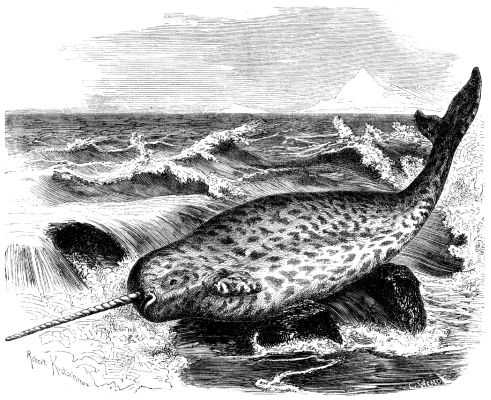
This Narwhal looks quite jolly, despite being beached on a gnarly rock. “Image of narwhal” from Brehms Tierleben. 1864-1869. Public Domain. Wikimedia Commons.

Narwhals are having a bit of a moment. Barnes and Noble lists six recent narwhal-themed titles (https://www.barnesandnoble.com/blog/kids/6-books-narwhals/) and GoodReads has a whopping twenty-five (https://www.goodreads.com/list/show/105601.Narwhal_Children_s_Books
).

But why?

I mentioned this to my sister and she said, “Yeah, because they’re like unicorns for boys.”

Okay, I thought, narwhals are attractive because they’re real and the “real” and “scientific” is associated with masculinity, versus “feminine” fantasy and romance. (Of course, historically unicorn iconography is much more ambivalent about gender but we’re talking about reductive marketing aimed at dividing kids into pink and blue sections of the toy/clothes sections at Target, etc.) I looked at my narwhal cellphone cover and thought it looked kind of gender neutral. Maybe narwhals were breaking down barriers between unicorns “for girls” (or at least not for “boys”) and making unicorns for everyone!

I thought I had cracked the narwhal question.

But then… I saw a giant, hot-pink plushie narwhal at the local CVS. And then I went to Barnes and Noble and saw this:
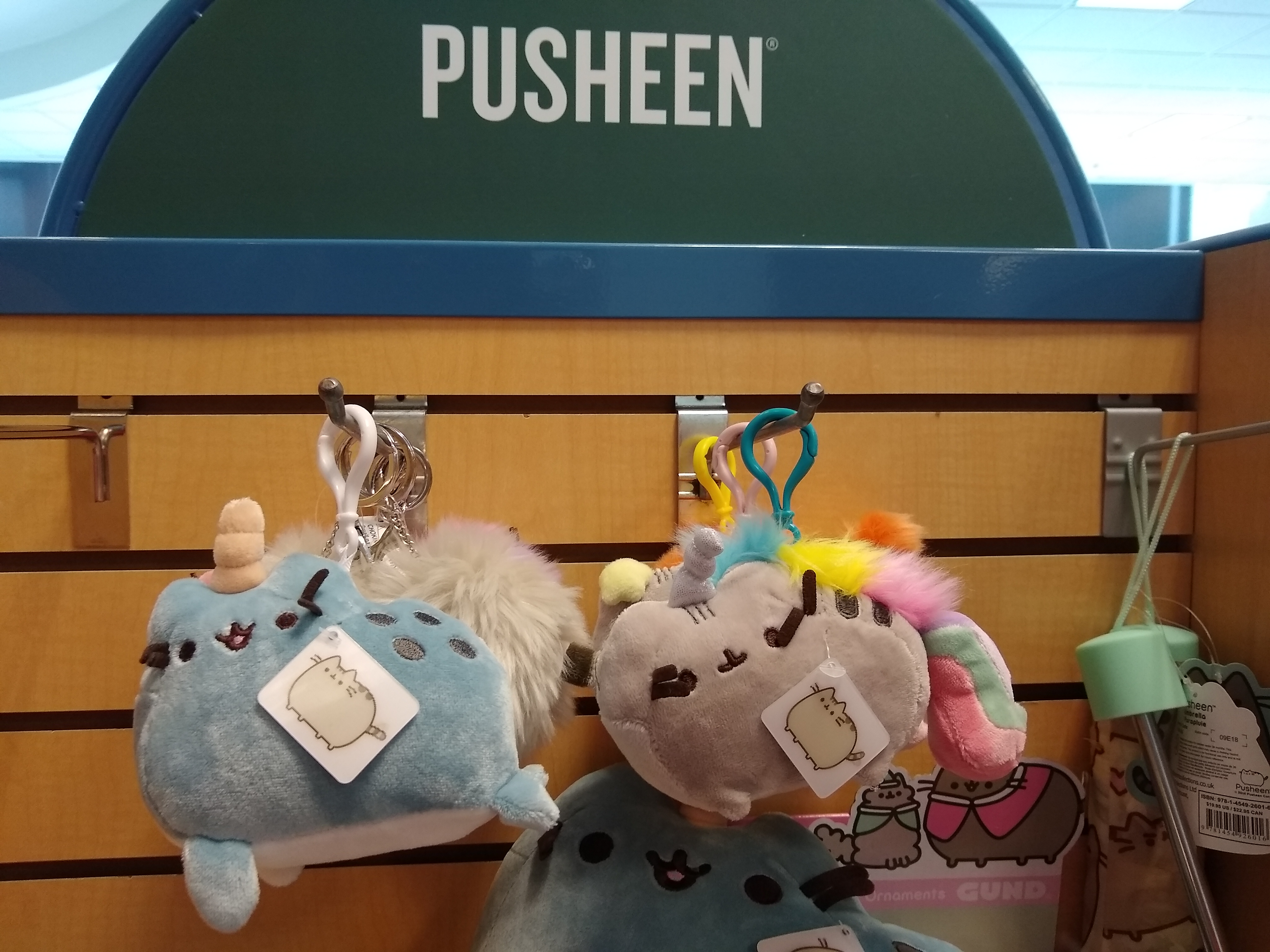
Why does a cat need to be either a unicorn or a whale? This confuses me. Self-respecting cats know that they are completely adequate as cats and need not compromise their cat-ness with sorbet-coloured manes and vestigial flippers.

And then I saw this:

Note the pearlescent and purply narwhal items stacked next to ye olde rainbow unicorn on the middle and bottom shelves.

Purple sparkly narwhals are not about “the real” or about the scientific existence of unicorns.

But at the same time, narwhals are not not about “the real.” The Narwhal and Jelly series is delightfully absurdist and Not Quite Narwhal plays on the way invisibility and non-existence aren’t at all the same and definitely messes with binary categories. Making a purple narwhal tape dispenser is playing on the image of an existent animal in a slightly different way than on a mythological figure if only by deliberately messing with “natural” representations.

But what does all this fun re-colouring and cutesifying of narwhal products do for a species threatened by the degradation of polar ice?

You kind of hope that the reality of narwhals in nature will inspire owners of narwhal plushies to get invested in maintaining the habitats of these amazing animals and investing emotionally (and eventually politically) in environmental protection.  I know that’s not the aim of product designers spinning off and innovating on the unicorn craze, but I hope it happens, nonetheless.

Anyways, if you are looking for some fun reading on narwhals that isn’t reducing them to commercial bunkus, National Geographic’s Mystery of the Sea Unicorn features a great 1694 illustration of a narwhal and an imaginatively rendered equine sea-unicorn. https://www.nationalgeographic.com/science/phenomena/2014/03/18/the-mystery-of-the-sea-unicorn/

There’s also a good summary on the World Wildlife Fund site: https://www.worldwildlife.org/stories/unicorn-of-the-sea-narwhal-facts
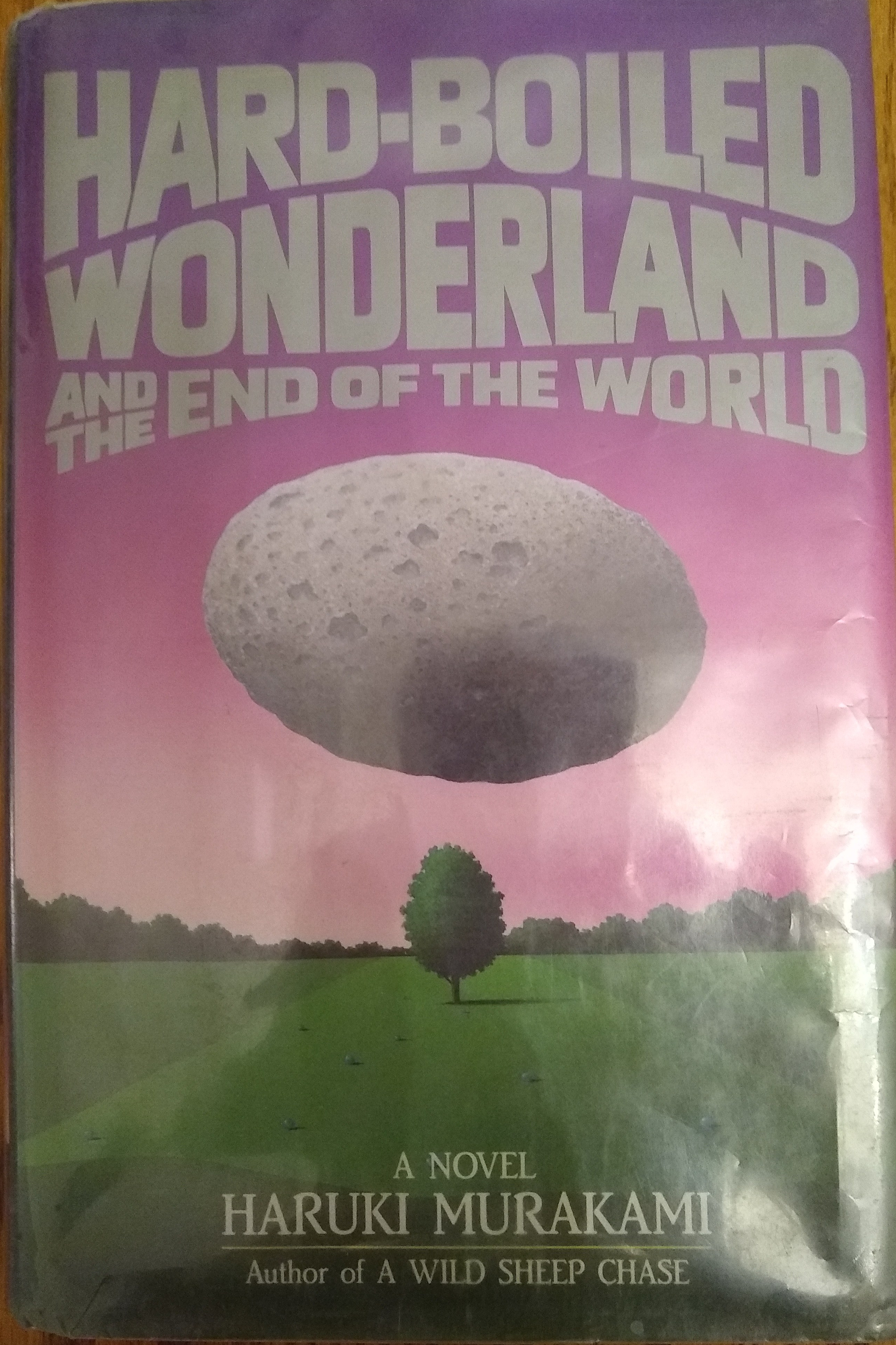
This novel is the epitome of offbeat unicorn-ness!

Hard-Boiled Wonderland is made of two entwined story threads. In first story thread, the unnamed protagonist receives a mysterious skull from an eccentric scientist that he deduces belongs to a unicorn…a realization that soon gets him into trouble. In the second story thread, the protagonist enters a mysterious Town, that has a herd of unicorns. The protagonist is tasked with reading old dreams from skulls…unicorn skulls. With these two versions of the protagonist decode the meaning of the unicorns? And if they can, can they stop the End of the World?

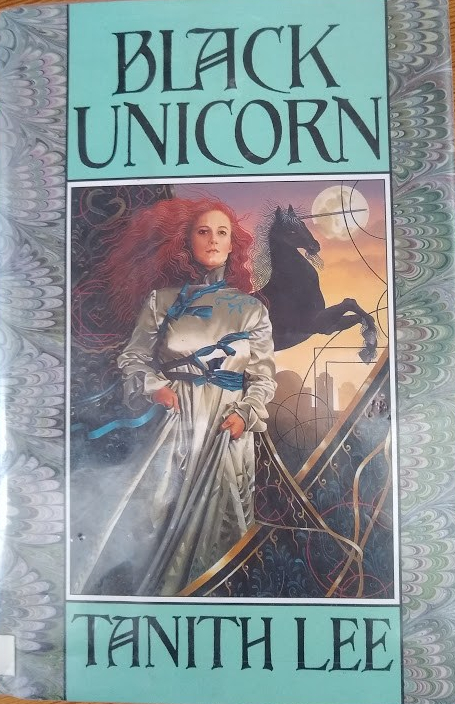
Behold my terrible photography skills…and the original US cover of Hard-Boiled Wonderland. I just want to point out that NOTHING in this cover is remotely related to the book! In fact, the leaden egg-moon thing hanging in the air has more to do with Tanith Lee’s Black Unicorn than it does this novel.

Well, can they?

If you’ve ever read a Haruki Murakami novel, you’ll know that stopping the end of the world is beside the point.

And I’m not going to spoil the ending, because we’re here to talk about unicorns.

Murakami ensures readers that he’s done his research on unicorn mythology. As a unicorn nerd and book nerd, one of my favourite parts was the protagonist’s trip to the local library where he enlists the librarian to help him research unicorns. The novel has several excerpts from Jorge Luis Borges’s Book of Imaginary Animals with quotations from Pliny and Leonardo Da Vinci. There are also anecdotes about the qilin, or “Chinese unicorn” heralding the birth of Confucius and offering warnings to Genghis Khan (95). He concludes, quoting Borges, that “In the East, peace and tranquility; in the West, aggression and lust. Nonetheless, the unicorn remains an imaginary animal, an invention that can embody any value one wishes to project” (97).

Murakami’s summation of the difference between unicorn and qilin is, perhaps, a bit disingenuous, because it overlooks a very important strand of western unicorn iconography, namely the Jesus-unicorn of medieval psalters and bestiaries, most famously in the unicorn tapestries. But this exclusion doesn’t matter too much because, as per Murakami’s postmodern playfulness, he’s writing a novel to riff off of Eastern and Western unicorn traditions, not reproduce them.

The representation of the Town’s unicorns is lovely and original, balancing the saccharine with observations out of a nature-guide. The unicorns possess all sorts of coloured coats, from dun to piebald, but they turn a uniform downy gold each autumn before “bleaching slowly to white” (142). So, as much as they possess individual markings, they are also made indistinguishable. Murakami’s unicorns play on the way preexisting unicorn mythology is equally invested in the animal’s elusive, ferocious immortality and in its inevitable death and rendering into skeletal objects used and prized by humans. Their mortality is also tied to poetic renderings of “ice-bound morning[s],” their “winter-whitened bodies lying under two inches of snow” (199). How and why the frozen bodies are turned into the bones the protagonist studies is you’ll have to read the book to discover. It’s enough to say that they are imbued with and evoke memory. This is something Tanith Lee’s The Black Unicorn also picks up on (which I discuss in my review here), but as far as I know, Murakami and Lee are the only ones to contemplate unicorn bones at any length.

As much as the cover has zero connection to the book, the inside cover shows that someone was paying attention! The protagonist in the novel spends a lot of time wandering around the mysterious town and this is perhaps the map he creates? Also, I get sentimental looking at old library slips! 2005 feels so long ago!

Murakami is perhaps at his best when he entwines history and fantasy, wherein a Russian paleontologist discovers a unicorn skull on a Ukranian plateau…shortly before it gets bombed to bits in the First World War. The survival and then disappearance of the unicorn skull is tied to the tumultuous political history of the early Soviet Union. The skull travels from the Eastern Front, to the universities of Leningrad, and is last spotted in a barn-turned-speakeasy. Material records of it disappear with the increasingly utilitarian turn of Soviet science.

This section could have been developed into a slim, freestanding novella; instead Murakami relegates it to a narrative cul-de-sac, leading nowhere. It tantalizes with the specter of a destroyed scientific record, the erasure of what our culture assumes (perhaps wrongly) to be the ultimate purveyor of truth.

To return to the Borges quotation, it’s this last clause which really matters to Hard-boiled Wonderland “unicorn remains an imaginary animal, an invention that can embody any value one wishes to project” (95). The unicorn reflects the intimate imaginative investment of the dreamer. Ultimately, the relationship between the two storylines and two unicorn skulls remains tantalizingly unresolved as the “fantasy” Town leaks into the “real,” low-fantasy dystopia of the primary storyline.  To resolve the relationship between the storylines and the possible reality of the unicorns would be to ruin the novel’s tone. So you just have to live with the delicious uncertainty of postmodernism. Ta-da!

Other stray notes:

  • Harry Potter nerds will rejoice in Murakami’s use of the Kappa Japanese water demon. (J.K. Rowling mentions them as a part of Professor Lupin’s curriculum in The Prisoner of Azkaban). These Kappas are gruesome subway-dwellers who worship a scary fish-god. Fun times!
  • Published in 1993, Hardboiled Wonderland represents a “reality” governed by Calcutecs and Semiotecs
  • As you’d expect in a Murakami novel, there’s lots of delicious descriptions of food and cooking and music.

Find Hard-boiled Wonderland and the End of the World here:https://www.amazon.com/Hard-Boiled-Wonderland-End-World-International/dp/0679743464

Behold, the unicorn!

Beautiful, isn’t he? And very mysterious…redolent with bovine charm.

Even if unicorns don’t exist naturally, it hasn’t stopped imaginative individuals from trying to make them.  Dr. W. Franklin Dove, of the University of Maine, used the creation of unicorn cattle and sheep in order to research horn physiology and tissue transplantation. But you can’t but suspect that he was also using his research to fulfill an imaginative inclination. In The Natural History of Unicorns, Chris Lavers suggests that Dove was inspired by the traditions of certain South African groups to shape the horns of their cattle and by Nepalese unicorn sheep gifted to the Prince of Wales as part of a collection of Nepalese animals in 1906 (203).  

So how does one make a unicorn? Dr. Dove took a day-old Ayrshire bull calf, removed the horn buds and transplanted them onto the center of its forehead. As the calf grew, the horn buds fused and grew into one horn. Hey presto! A unicorn!

To what effect? It seems the bull was a rather mischievous unicorn, who “is conscious of peculiar power” and “recognizes the power of a single horn which he uses as a prow to pass under fences and barriers in his path” (Dove qutd in Lavers 213). The unicorn, when created, grows independent and resists domestication, like its mythological counterpart.

The 1930s, we may recall, was not exactly a highpoint in thoughtful, considerate scientific experimentation. Even talking about the creation of a unicorn has the potential to inspire budding mad scientists.

Like me!

I first read about Dove’s unicorn bull in a book on unicorn mythology when I was ten or twelve. I immediately planned to become a veterinarian, biologist, or zoologist or something that would give me the skills to make a unicorn.

But I made the mistake of telling a friend of my parents my plans at a dinner party.  

“I don’t think that will pass the ethics board,” the grown-up said. Then they explained to me that experiments with animals have to “benefit mankind” or something equally inconvenient and unimaginative. “Because then unicorns could exist” was not going to cut it. And because Lamarckian evolution had been debunked, my hypothetical unicorns were not going to create a beautiful new species of bovine unicorns. Also, mad scientists don’t get grant funding.

 After that, I lost my interest in becoming a scientist. Which is probably good news for all those goats and bulls who get to keep their horns in their proper places.

More Reading:

Lavers, Chris. “The Scientist’s Unicorn” in The Natural History of Unicorns. London: Granta, 2009. 196-216

Dove, W. F. “The physiology of horn growth: A study of the morphogenesis, the interaction of tissues, and the evolutionary processes of a mendelian recessive character by means of transplantation of tissues.” Journal of Experimental Zoology, 69 (1935): 347–405. https://onlinelibrary.wiley.com/doi/pdf/10.1002/jez.1400690302

McCurry-Schmidt, Madeline. “Dr. Dove’s Unicorns.” Scientific American. 29 November 2011. https://blogs.scientificamerican.com/guest-blog/dr-doves-unicorns/

The site http://www.unicorngarden.com/drdove.htm has some images of more recent experiments. Obviously, these people didn’t ask the ethics board…

Black Unicorn by Tanith Lee. New York, Atheneum, 1991. (Newer editions are available on Amazon, but check out the awesome early 1990s cover of my library copy!)

Genre: Secondary world fantasy, multiverse

Ideal Age Range: 12+

Short Review

Sixteen-year-old Tanaquil yearns to escape life in her sorcerer-mother’s desert fortress. Her “mechanical” talent to fix things is not appreciated in a place where she regularly misses breakfast – because it has transfigured and escaped (6). But after an experiment goes wrong, Tanaquil finds herself cut loose from everything she once knew and followed by a terrifying one-horned beast. Finding herself moored in a foreign clockwork city, Tanaquil discovers that her talent to fix things is not as incompatible with magic – and unicorns – as she once assumed. Black Unicorn thrives on lush and unusual description. The vertebrae of a mysterious “milk-crystal” skeleton (12) look like “star flowers” (18). A unicorn’s mane flows “like acid” (32). The black unicorn is a mysterious avenger, providing a refreshing alternative to the norm of placid or cute unicorns who function as sentient friends to human protagonists. Despite the fearsomeness of the unicorn, this novel can be enjoyed by older children as well as teens alike. 

Buy Black Unicorn here:https://www.amazon.com/Black-Unicorn-Ibooks-Fantasy-Classics/dp/1596871628/ref=sr_1_1?s=books&ie=UTF8&qid=1548210479&sr=1-1&keywords=black+unicorn+tanith+lee

Analysis (spoiler alert)

Black Unicorn can be read as lushly written, if structurally simple story about adolescent self discovery…BUT YOU WOULD BE WRONG! Black Unicorn is also about relational selves, the limits of empathizing with friends, humans’ attempts to control “reality” through technology, and the function of symbols in manipulating citizens. Continue reading

Genre: Memoir, Humour
Ideal Age Range: 14+


This funny and bracing memoir has very little to do with unicorns on a literal level. On the other hand, maybe it is, as the title suggests, all about unicorns.

The unicorn is in the memoir’s opening anecdote, where young Tiffany is cursed with a spiky wart on her forehead. She is desperate to transform the attention she gets from her classmates from derision to awe, to go from being Dirty Ass Unicorn to the Last Black Unicorn (4).
Haddish’s description of a life episode as a “weird fairy-tale horror story” seems to apply to her experiences generally (45). Like a fairy tale heroine, Haddish is able to spin straw (or dung) into gold. As a teen barely able to read but with a powerful memory, Haddish ends up in AP classes; an attempt to impress a boy ends up with her first winning a Shakespeare monologue competition and Bar Mitzvah entertainment; when her joking goes awry in class, she is given the choice between therapy and comedy camp. Just so, the memoir offsets this string of successes with her mother’s mental illness, the horror of foster care, the way these early experiences result in a string of abusive personal relationships, the politics of managing relationships in comedy.


Fairy tales in their original forms are often violent and heroes often encounter random, seemingly unpleasant events. Remember when Rapunzel is thrown out of her tower for getting knocked up and then has twins on her own in the wilderness? Or when the frog turns into a prince after the princess throws him against a wall for sneaking into her room? Or when Little Red Riding Hood is forced into a strip tease and then tells the wolf she needs to take a poop in order to escape? No? Well, get thee to the 1812 version of the Grimm’s fairy tales. The point is that original fairy tales are often also horror stories. Their narrative tension works on how heroes and heroines survive and succeed in terrible circumstances that are often the result individual cruelty enabled by systematic societal injustice.


Heroes and heroines of fairy tales often don’t succeed because they are “good” but because 1) they find ways to get help and 2) they are clever and crafty. Kevin Hart and Jada Pinkett Smith appear like fairy godmothers, reminding us that success emerges not from individual striving alone, but from mentorship, friendship, and investment in human relationships. Alongside Haddish’s recognition of the generosity of others, she’s gleeful in describing her ability to avenge herself both in wickedly inventive schemes to get back at terrible ex-boyfriends and by being the better person to colleagues who underestimate her. In fairy tales, happily-ever-after indicates stasis, a lack of movement. But Haddish reveals how she has to act like she’s got her happy ending to make sure her opportunities keep coming.


But if the victories of fairy tale heroes and heroines are satisfying, but they are also implicitly rare. The bones of unsuccessful princes are woven through the briars of Sleeping Beauty’s castle. The Black Unicorn of Haddish’s title is also the “Last,” which is significantly less optimistic than the “First” Black Unicorn or even “A” Black Unicorn among many. So…If unicorns are rare, extraordinary creatures, are we to read Haddish as exceptional both because of her talent and ambition, or because she succeeds despite massive challenges? Both?


Haddish considers how the desire for being “wanted,” to be protected and wanted underlie her love of performance. Performance and comedy allow her to be “something that other people wanted me to be” (274). When no unicorn exists, Haddish makes herself one.


Oh, and unicorns do pop up twice. Read it to find out where!

Buy The Last Black Unicorn here: https://www.amazon.com/Last-Black-Unicorn-Tiffany-Haddish/dp/1501181823

earlier-lion-unicorn-tenniel

Last week, I briefly mentioned Aslan the Lion and Jewel the Unicorn in The Last Battle as similarly supernatural creatures who, together, represent the spiritual unity of Narnia. When people stop believing in the lion and stop fearing the unicorn, Narnia collapses. C.S. Lewis wasn’t working in a vacuum and the threat to the lion and unicorn isn’t just about a threat to Narnia, but also a threat to Great Britain, whom lions and unicorns traditionally represent.  (To see just how present the lion and unicorn iconography is, check out the coat of arms in the top left hand corner of Queen Elizabeth’s website: https://www.royal.uk/her-majesty-the-lion and unicorn emblemqueen)

So, the Lion and the Unicorn are famous emblems of Great Britain, but they are not peaceful or cooperative ones. The dominating, kingly lion has been part of English royal heraldry since the medieval Plantagenets, but the feisty unicorn was the symbol of resistant, rebellious Scotland. If Scotland became part of England during the 1707 Act of Union, it wasn’t to please the Scottish. (They had rebellions in 1715 and 1745, and though the independence referendum of 2014 narrowly failed, Brexit is testing that union once more.) Therefore, the lion and the unicorn might equally be holding up the crown together…or wrestling for it.

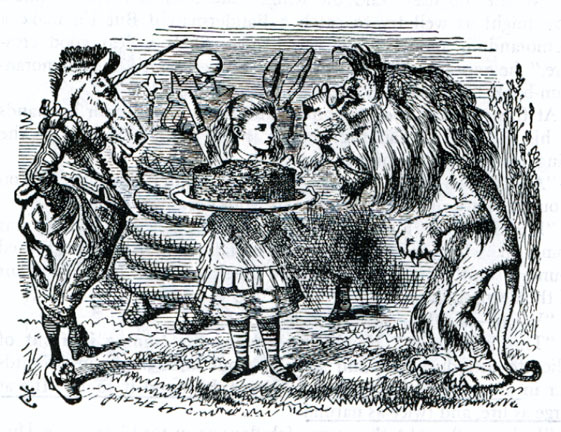
The tension between the lion and unicorn is so ingrained that there’s a nursery rhyme about it. Lewis Carroll’s Alice cites “the old song” in Through the Looking-Glass:

The Lion and the Unicorn were fighting for the crown:

The Lion beat the Unicorn all round the town.

Some gave them white bread, some gave them brown:

Some gave them plum-cake and drummed them out of town

The lion and the unicorn come, over the years, to represent the two main political party leaders. In the 1853 Punch cartoon, the unicorn is the conservative, pro-national and pro-imperial Disraeli and the bespectacled lion is the liberal, reform-oriented Gladstone. This signals a weird inversion of the lion and unicorn’s original affiliations. While the English lion once dominated the independent-minded Scottish unicorn, now it is the unicorn who waves the Union Jack and bears a warlike shield.

earlier-lion-unicorn-tenniel

llustration to “The British Lion” in Punch (Jan-June 1853). For more, see Michael Hancher’s “Punch and Alice” in Lewis Carroll: A Celebration. Ed. E Guiliano, New York, 1982. Or go to the useful site where I found the image: http://www.alice-in-wonderland.net/resources/analysis/picture-origins/

In a meta method appropriate to Wonderland, Tenniel satirizes the satire. Eighteen years after the original cartoon, in Through the Looking-Glass (1871), the unicorn sports a Union Jack suit (that is also Elizabethan) and sports Disraeli’s equine nose. The lion is even more worn-out, sporting Gladstone’s glasses. He’s also deprived of any clothing. Being a stay-at-home lion no longer seems so attractive.

Lion_and_Unicorn

Tenniel, John. “The Lion and the Unicorn.” Through the Looking-Glass by Lewis Carroll. 1871.  London: Penguin, 1998.  202.


In 1876 an American magazine, Harper’s Weekly, picks up on the imagery as well…

The Lion and the Unicorn Fighting-Again.17 June 1876.. HOUSTON.jpg

Image Citation: Nast, Thomas. “The Lion and the Unicorn Fighting-Again(?)” Harper’s Weekly. 20.1016 (17 June 1876): 496.

The image bears the caption:

“The Lion and the Unicorn Fighting”–Again(?)

British Lion (to Lord D — Unicorn). “What! give up the Fugitive Slave, and not the Criminal Fugitive?”

Ok…..

On first look, this is rather weird, since the cartoon is from ten years after the American Civil War. But, if you look closely, you’ll see that this has to do with the UK-US extradition treaty case of Ezra D. Winslow in 1876. Leonine Gladstone and Unicorn Disraeli were famous political rivals. In 1876, Disraeli was Prime Minister and Gladstone was the leader of the Liberal opposition. The bug-eyed Unicorn Disraeli seems rather surprised that the lion is bringing up past unpleasantness (to put it mildly). Neither were what we would call progressives when it came to American slavery, and though slavery was termed illegal in England in the 1772 Somersett case, and the trade ended in 1807, slavery was only abolished in the British empire in 1833. Gladstone’s reputation as a liberalizer had to do with widening (normatively white male) voting rights.  So it’s a little surprising to see American cartoonists aligning him with the protection of fugitive slaves.

Anyways, it’s clear that through the nineteenth century, the lion and the unicorn symbolize robust debate about what unites – and divides – the United Kingdom.

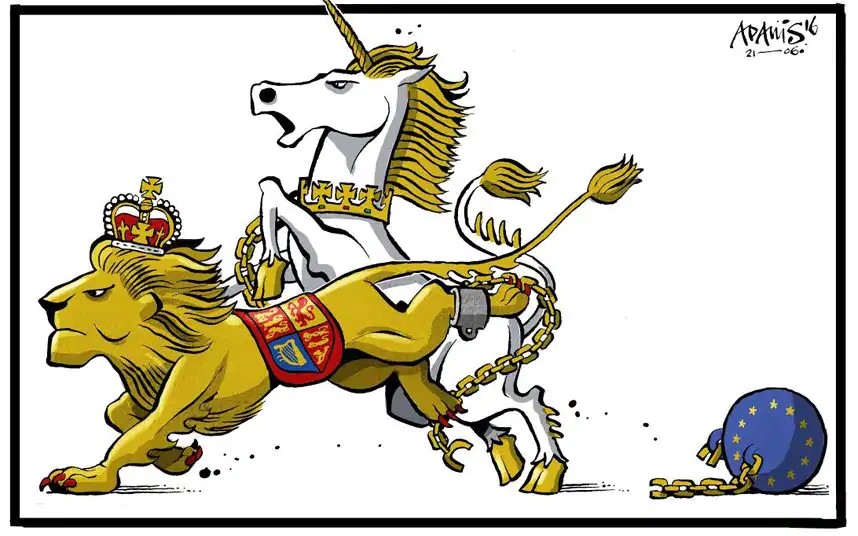
More recently, in 2016, The Telegraph ran a pro-Brexit cartoon of the lion and unicorn running together away from the European Union.

lion and unicorn brexit

(Go to https://www.telegraph.co.uk/news/2016/06/23/wewantout—tell-us-why-you-hope-leave-will-win-the-eu-referendu1/ to read the article. Hindsight stings, eh?)

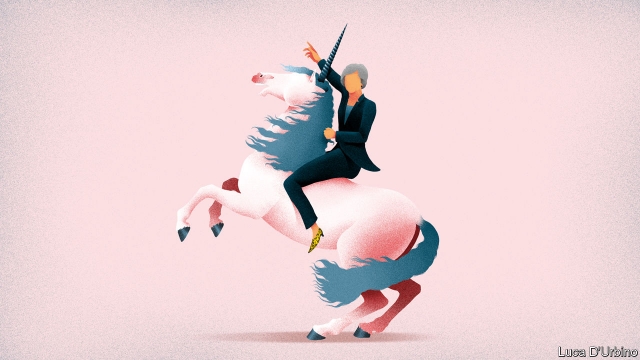
Ironically, when the lion and unicorn aren’t fighting over the terms of a “United” Kingdom, disaster follows. In 2019, the Economist ran a cartoon of Theresa May riding a unicorn, with no lion in sight. And that was a testament not to the UK’s power, but to its delusions of an easy path back to independent greatness and the fantastical quality of May’s ability to hold onto her position as prime minister. The lion, once a symbol of expansion, then of stay-at-home Englishness,  has disappeared entirely. Instead, we have the delusional unicorn leading Britain west, away from Continental Europe.

Theresa May Unicorn

(Go to https://www.economist.com/britain/2019/01/31/theresa-mays-temporary-triumph to read up on this!)

To drive the point home, on 6 February 2019, the Independent ran a story about May being accused of “chasing unicorns” in her Brexit dealings. Oof.

So…the lion and unicorn aren’t just pretty figures holding up a crown. They are important symbols of a history of political strife in the United Kingdom and the creative tension required to keep it together.

ARTSTOR_103_41822001074465

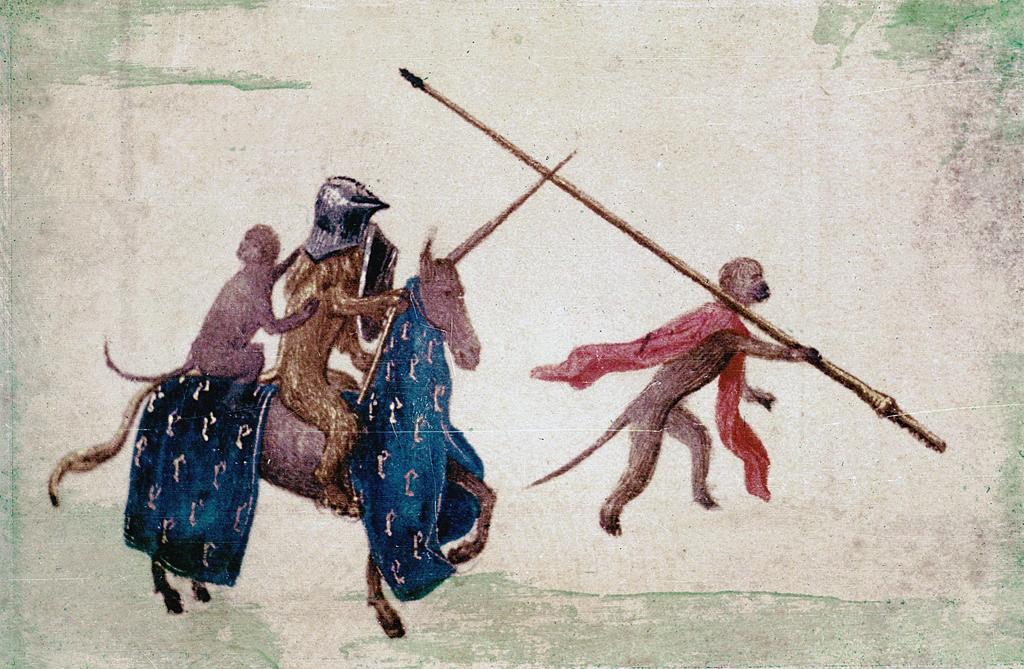
Image Citation: Master of Mary of Burgundy, fl. 1475-1490. “Lion on Unicorn.” Book of Hours of Engelbert of Nassau ms. Douce 219/220 fol. 159. c.1480-90. Bodleian Library.

This post comes off of last week’s consideration of C.S. Lewis’s The Last Battle. Lewis’s novel starts with a monkey and a donkey dressing up as a human king and a supernatural lion (Aslan). The monkey and donkey are soon confronted by an actual human King Tirian and an actual supernatural being (the unicorn Jewel). It is the king and unicorn’s utter failure to reveal the charade that leads to the destruction of the political structure of Narnia. It might be worth noting that the lion and the unicorn are heraldic emblems of Britain – if the destruction of Narnia echoes post-World War II anxieties about not only nuclear apocalypse, then the role of Puzzle in challenging Aslan and Jewel might reflect Lewis’s worry about social destabilization.

But the monkey and donkey’s parody is not a new thing.

The Last Battle Page 11 Puzzle and shift

Image Citation. Baynes, Pauline. “Puzzle and Shift.” The Last Battle by C.S. Lewis. London: HarperCollins, 1956. 11.  Enter a caption

The Last Battle Page 15

Image Citation. Baynes, Pauline. “King Tirian and Jewel.” The Last Battle by C.S. Lewis. London: HarperCollins, 1956. 15.  

This week, I’m featuring two images are part of a set called the “Grotesque Tournament” from the Book of Hours of Engelbert of Nassau. This Flemish manuscript was hand-written and hand-illustrated c.1480-90. The painstaking illustrations mean that someone put a lot of thought and effort into…using monkeys to mock unicorns. The monkeys aren’t just mocking unicorns, they’re mocking the idea of chivalry. Though there’s a lion riding the fake unicorn in the image above, they aren’t mocking Great Britain specifically…the heraldic combination of the English Lion and Scottish Unicorn only occurred in 1707 with the Act of Union. Instead, there’s a general topsy-turvy reversal of power structures. Mikhail Bakhtin developed the idea of the carnivalesque to address moments like these, like the Feast of Fools, when hierarchies were temporarily inverted. But in such moments, the reversal is a temporary release of stress…to have it last longer is to (like in Narnia) destroy the culture itself.

Which is bad, if you side with C.S. Lewis, Jewel, Aslan, and King Tirian. But it might not be bad if you don’t have much power. Like if you’re a medieval woman…

ARTSTOR_103_41822001074283

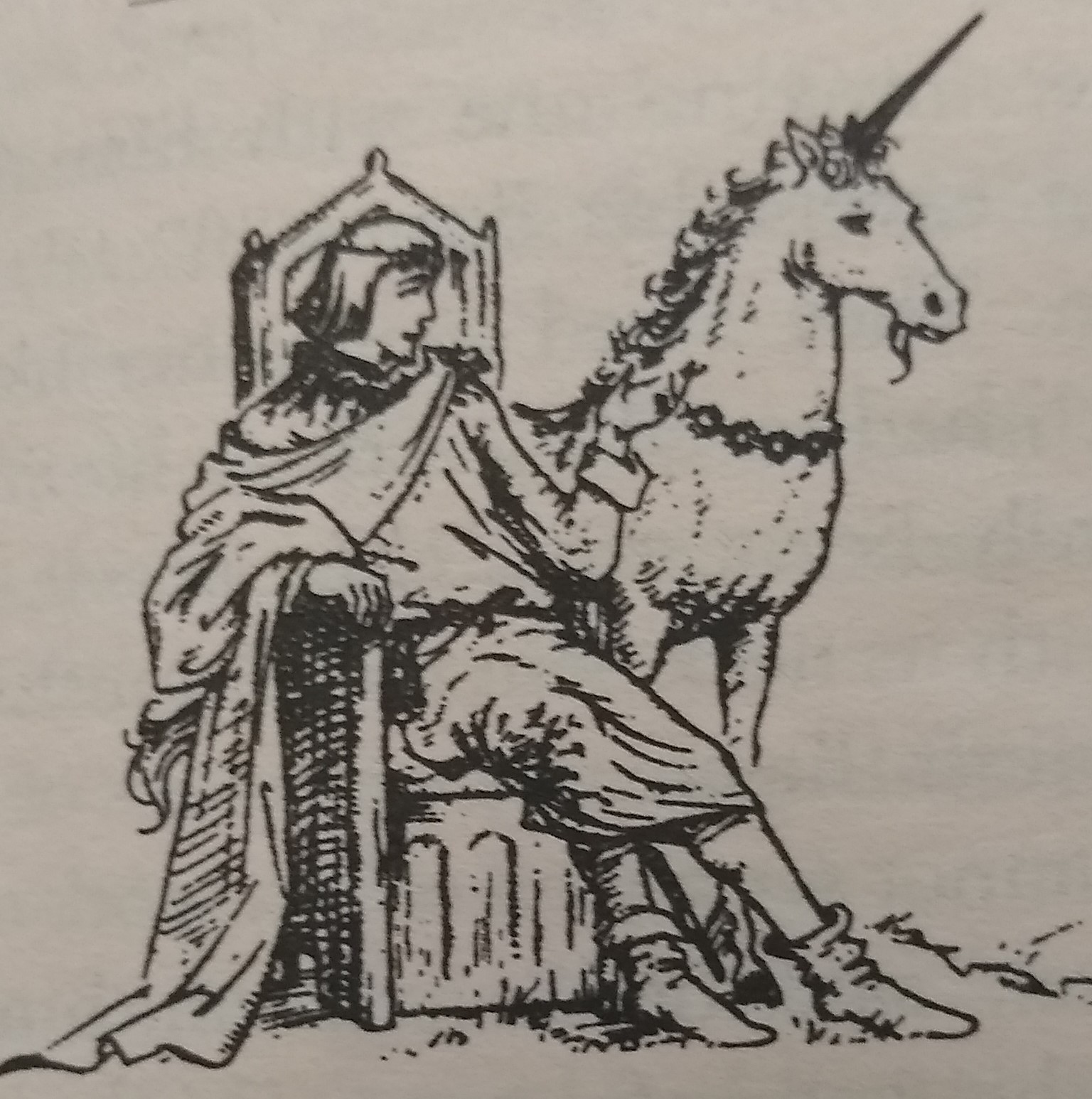
Image Citation: Master of Mary of Burgundy, fl. 1475-1490. “Lady and Mock Unicorn.” Book of Hours of Engelbert of Nassau ms. Douce 219/220 fol. 96v. c.1480-90. Bodleian Library.

Here we see a young noblewoman contributing to the creation of the mock-unicorn.

This works on several levels. Virgins are the only ones to attract real unicorns, so this lady’s sneaky creation of a mock unicorn may say something about her love life. In preparing the unicorn for a joust, she’s also undermining the manly virtues of combat. But it cuts both ways.  She’s in on the joke with the monkey…but does that mean that she (as a woman) is on the same level as the animals? When the monkeys in these images hold horses and lances, they are doing the work of squires and pages. I wonder whether they stand in for children or rebellious young people?

Monkeys vs unicorns…monkeys win! But whether that’s good thing or not depends on the interpretation of author, illustrator, and reader alike.


Lastly, for anyone who wants to check out this amazing book or other beautiful manuscripts, the Bodleian Library at Oxford has an amazing digital collection: https://digital.bodleian.ox.ac.uk/?#

Digital collections like these are the internet done right!

Genre: children’s literature, classic, secondary world fantasy, portal fantasy, apocalypse, Christian fantasy

Ideal Age Range: 8+

The Last Battle was prthe last battle coverobably the first “hard” book I read. The next time I read such a hard book was when I was sixteen or seventeen and read All Quiet on The Western Front (everyone dies in the cultural apocalypse of the First World War). (To my shame, I came late to The Diary of Anne Frank.)

This cover was the beginning of the problem. A bloody-horned unicorn looks over his shoulder as the sun rises? Sign me up! This unicorn meant business. He was heroic, noble, epic.

I wasn’t expecting him also to be dead.

Short Review
In the last days of Narnia, King Tirian and his unicorn companion Jewel set off to confront unsettling rumours of destruction at the edges of the kingdom. A monkey and donkey dressed as a lion seems like an unlikely nemesis for the young king, but soon good intentions and impulsive heroics set the apocalypse into motion. Tirian, Jewel, and their British world-crossing companions Eustace and Jill must confront the end of one world and the beginning of another.

Written in straightforward prose with lots of action, The Last Battle is accessible to young readers. It is also notoriously upsetting because of its subject matter (the end of the world). The dread and suspense of The Last Battle emerges not in wondering what will happen (the narrator is quite clear that Narnia is ending) but how characters face their fate. Current Young Adult literature and some children’s literature has increased its engagement with difficult issues, but rarely are endings so final. Young Jill’s hopes reflects a common trope of literary consolation: “Our world is going to have an end some day. Perhaps this won’t” (110). (In children’s literature at large, this translates to: This story has a sad ending so perhaps yours won’t.) Sorry, Jill. Both our world and our fantasy world end. That being said, Lewis does offer consolation and a “happy ending,” but it’s not one many readers find easy to digest.

It’s also worth mentioning that Lewis is canny enough to complicate the orientalist representation of the Calormenes and classist representations of dwarfs even as he show mid-twentieth-century British biases. Current readers might find, in his horror of garlic and onions, grounds for the critique he levels at xenophobic dwarfs — he doesn’t know what he’s missing.

Analysis below Continue reading

Genre: Post-apocalyptic fantasy

Ideal Age Range: 13+

Summary:

Wandering through a postapocalyptic landscape, young scavenger Pete Garey befriends a wisecracking unicorn named Ariel. When a malevolent necromancer threatens Ariel’s life, the duo set out from Florida to New York in order to confront the source of evil. Along the way, Pete and Ariel’s intense bond comes under stress as they come increasingly in contact with other humans. Having been separated from friends and family as a young teen, Pete’s connection to Ariel relies on his “purity.” Virtues worn easily in the wilderness begin to chafe as Pete, now a young man, seeks the recognition of fighting men and is troubled by his attraction to women.  Ariel, on the other hand, balances her sharp-tongued with wisdom. The novel’s emotional core is leavened by generous portions of violent action – in this brave new world, heroes and villains apply katanas, claymores, and crossbows with gusto. While certain plot threads are never fully resolved and canned food seems a little overabundant five years after the apocalyptic “Change,” Pete and Ariel’s quest of self-discovery on the road has ample excitement and heart.

Buy Ariel here:https://www.amazon.com/Ariel-Steven-R-Boyett-ebook/dp/B00J5X5OZO/ref=sr_1_1?s=books&ie=UTF8&qid=1548210295&sr=1-1&keywords=ariel+steven+r+boyett

Analysis below (with some spoilers) Continue reading

This woodcut is an example of religious critique from a position of faith. The unicorn, who symbolizes purity — and Jesus — tips over the pope’s crown. The crown, or papal tiara, no longer signals divine authority but the use of institutional religion to bolster earthly power and hierarchy. We see the pope setting himself over an ordinary peasant parishioner as he hears confession. In this configuration, the pope’s role is to absolve the commoner of his sins. But the commoner is on the same level as the unicorn — he shouldn’t need anyone’s intervention to pray or to access God. This woodcut is from the early Reformation, when followers of Martin Luther were challenging the authority of the Catholic Church. This unicorn is definitely on the side of the emerging Protestants. In our day, the image is still resonant, speaking to the triumph of truth over institutional power, abuse, or corruption. Perhaps the tippiness of the papal tiara is why modern popes since 1964 have chosen to wear the more-difficult-to-dislodge skullcap?

Image citation: Erhard Schoen, not before 1491-1542. A Unicorn Dislodges the Pope’s Tiara. 1527. http://library.artstor.org.ezproxy.library.tamu.edu/asset/BARTSCH_6040064. Web. 15 Aug 2018.